Magnetic Scale: Principle, Features and Industrial Applications
Classification:
Knowledge
Release Time:
2026-09-03
Author:
1
Source:
1
In modern precision manufacturing and industrial automation, accurate displacement and position measurement are the core guarantees of equipment stability and product quality. As a mainstream high-precision measuring component, the magnetic scale (magnetic grating scale) has gained wide recognition in the industry for its unique magnetic induction measurement principle, excellent environmental adaptability and cost-effective precision performance. Different from traditional optical scales, magnetic scales rely on magnetic field signal detection to complete position monitoring, breaking through the environmental limitations of optical measurement and becoming a preferred measuring solution for harsh industrial scenarios.
1. Basic Structure & Working Principle
A complete magnetic scale measurement system consists of two core parts: a magnetic scale strip and a magnetic read head, matched with a dedicated signal processing circuit. The overall structure is compact, easy to install, and highly adaptable to different equipment structures.
The magnetic scale strip is the benchmark component of the system. It is made of high-strength metal or engineering plastic substrate, with evenly spaced alternating N-S magnetic pole arrays precisely recorded on the surface through professional magnetic coding technology. The fixed magnetic pole pitch forms a stable and accurate magnetic measurement reference scale. The magnetic read head is equipped with high-sensitivity magnetoresistive (GMR) sensors, which are responsible for real-time induction of magnetic field changes.
The working process follows the principle of magnetic field induction and signal conversion: when the read head moves linearly or rotationally along the magnetic scale strip, the internal sensor continuously captures the periodic changes of the alternating magnetic field. The sensor converts subtle magnetic field flux density and direction changes into analog electrical signals, and the subsequent circuit performs signal amplification, filtering and high-precision interpolation calculation. Finally, the mechanical displacement data is converted into readable digital position information, realizing real-time, high-resolution position measurement.
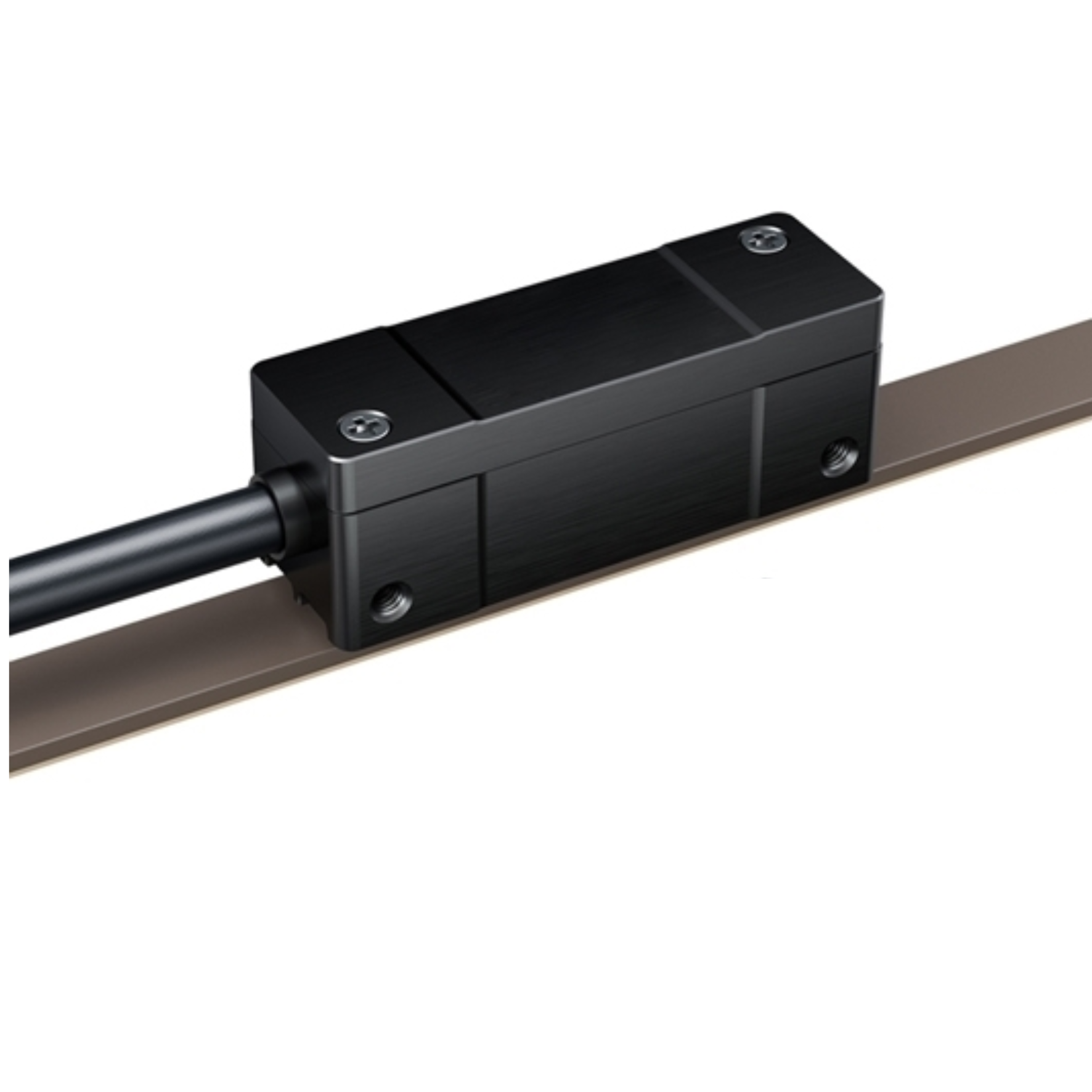
2. Core Advantages of Magnetic Scales
Compared with optical grating scales, laser scales and other precision measuring components, magnetic scales have prominent comprehensive advantages, especially suitable for complex industrial working conditions:
Strong Environmental Adaptability
Magnetic signal measurement is not affected by light, dust, oil mist, water vapor and fine metal debris. It can work stably in dusty, humid, oily and other harsh industrial environments that are not suitable for optical measuring equipment, effectively avoiding measurement failure caused by lens contamination and light source interference.
Excellent Mechanical Durability
The magnetic scale strip has no fragile optical components, with strong vibration resistance, impact resistance and wear resistance. It can withstand frequent mechanical movement and equipment vibration, with low failure rate and long service life, greatly reducing equipment maintenance frequency and replacement cost.
High Precision & Flexible Resolution
Through advanced signal interpolation technology, magnetic scales can achieve a resolution of up to 0.1μm, with stable full-stroke measurement accuracy. It supports incremental and absolute measurement modes, meeting the precision requirements of different scenarios from general automation to ultra-precision processing.
Simple Installation & Low Cost
The magnetic scale strip is lightweight and flexible, with low requirements for installation flatness and alignment tolerance. It supports long-distance customized processing, and the overall procurement and installation cost is significantly lower than high-precision optical scales, with higher cost performance for large-scale industrial application.
3. Main Industrial Applications
With its reliable performance and strong practicability, magnetic scales are widely used in precision processing and automatic control fields, covering almost all scenarios that require accurate position and displacement feedback:
- Machine Tool Processing: Applied to CNC machine tools, milling machines, lathes, grinding machines and other processing equipment, to realize real-time positioning and stroke control of tool and workbench, ensuring processing dimensional accuracy.
- Automation Equipment: Used in automated assembly lines, linear motion modules, robotic arms, and lifting positioning equipment to improve the positioning accuracy and operation stability of automated production.
- Precision Measuring Instruments: Matched with digital display meters, used in precision detection tools, coordinate measuring equipment, and laboratory precision displacement monitoring.
- Special Industrial Scenarios: Suitable for metallurgy, textile, printing, packaging and other industries with heavy dust and oil pollution, as well as outdoor machinery and hydraulic equipment with harsh working conditions.
4. Summary
As a mature and reliable precision measuring device, the magnetic scale perfectly balancesmeasurement accuracy, environmental adaptability and economic efficiency. It overcomes the fragility of optical measuring equipment and the low precision of traditional mechanical measuring components, providing stable and high-precision position feedback for industrial automation and precision manufacturing. With the continuous upgrading of industrial manufacturing standards, magnetic scales have become an indispensable core component in high-efficiency and high-quality industrial production, and their application scope is still expanding continuously.
Key words:
Magnetic Scales,linear scale
The previous one:
More information
ONLINE MESSAGE
Please fill in the information accurately and keep your communication channels open. We will contact you as soon as possible
Quick Navigation





Focus on the research and development of encoders and sensor-related products.
Give us an email to surprise you
Contact Us

